

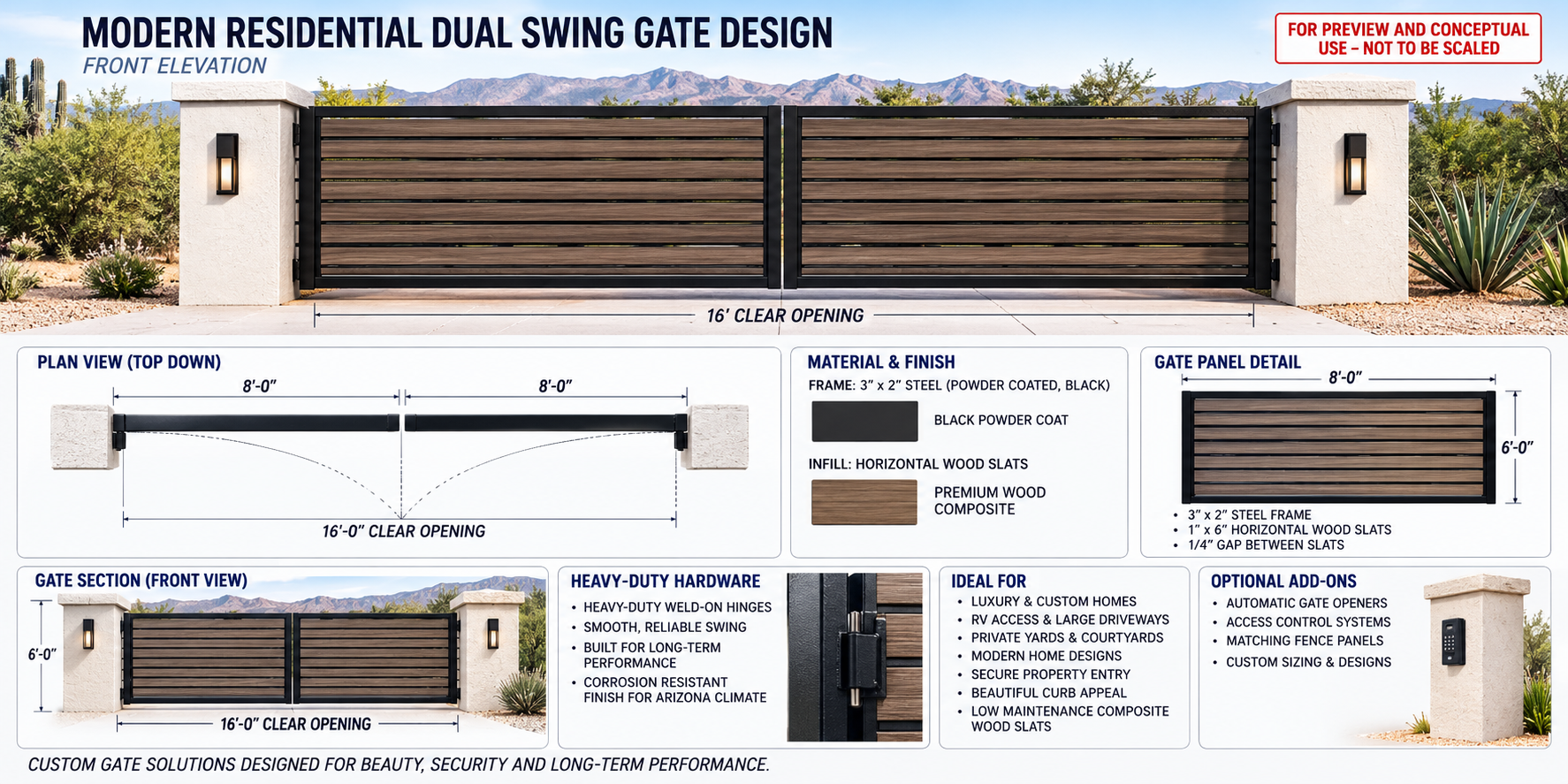
How to Plan a New Driveway or RV Gate
A homeowner’s guide to swing vs. slide gates, custom steel fabrication, privacy, automation, access control, and Arizona site conditions.
A custom driveway or RV gate can improve privacy, security, access, and curb appeal. But the best gate projects are planned as complete systems before fabrication begins.
Instead of building a gate first and asking how to automate it later, plan the gate frame, posts, movement, operator, power, safety devices, and access control together. That produces a better-looking gate and usually a more reliable automatic system.
Step 1: Measure More Than the Opening
Begin with the clear driveway opening, but also evaluate the surrounding space.
- Available swing area
- Side room for a sliding gate
- Driveway slope and grade
- Walls, columns, landscaping, and parked vehicles
- Fence line and setbacks
- Location of utilities, electrical power, and future conduit
A gate that technically fits the opening can still be the wrong design if it interferes with vehicle movement, landscaping, slope, or the space needed for the operator.
Step 2: Choose Swing or Slide
A swing gate can provide an attractive residential appearance and works well when the driveway has enough flat, open space for the gate to move. A slide gate moves horizontally along the fence line and can be a better solution when swing space is limited or the entrance needs a more commercial-style traffic pattern.
Manufacturer reference: Nice/HySecurity describes swing gates as best suited to driveways with flat open space available for gate motion. Nice / HySecurity Swing Gate Operators
Manufacturer reference: Nice/HySecurity offers slide-gate solutions ranging from residential driveways to critical infrastructure. Nice / HySecurity Slide Gate Operators
Step 3: Decide How Much Privacy You Want
- Open ornamental steel
- Decorative pickets
- Partial privacy panels
- Composite slats
- Corrugated or formed steel panels
- Expanded-metal or specialty infill
- Full-privacy steel or composite designs
Privacy is especially useful for RV parking, boats, trailers, side yards, pool equipment, and storage. The tradeoff is wind loading: a solid gate catches significantly more wind than an open picket gate, which affects frame stiffness, posts, hinges, footings, and operator selection.
Step 4: Build the Gate for Automation
- Frame remains square and rigid
- Hinges or rolling system are properly sized
- Operator attachment points are structurally sound
- Gate moves freely without the operator
- Stops and clearances are planned
- Posts and foundations are designed for gate weight and wind
The operator should move the gate. It should not function as the structural brace holding a weak or sagging gate together.
Industry reference: DASMA notes that structural gate design is directly related to safe automation and operator longevity. DASMA Structural Considerations of Swing Gate Automation
Step 5: Give the Hinge Post the Attention It Deserves
On a swing gate, the hinge post carries the gate and resists leverage every time it moves. A heavy or long gate attached to an undersized post or inadequate footing can sag even when the gate frame itself is strong.
- Gate length and weight
- Wind exposure
- Post size and wall thickness
- Footing design
- Hinge spacing and capacity
- Connection to adjacent walls or fencing
Step 6: Choose the Operator for the Gate and Usage
Operator selection should consider gate type, length, weight, wind loading, power availability, and how frequently the gate will cycle.
Manufacturer reference: LiftMaster currently lists the LA500UL as a residential/light-commercial linear actuator and the CSL24UL as a high-traffic commercial slide operator rated for gates up to 50 feet and 1,500 pounds. LiftMaster CSL24UL Specifications
Manufacturer reference: LiftMaster also lists multiple solar-capable residential and commercial gate operators. LiftMaster Solar Gate Operator Options
Step 7: Plan the Power Before the Hardscape Is Finished
- Dedicated electrical circuit where appropriate
- Low-voltage control wiring
- Conduit for future accessories
- Battery backup
- Solar where appropriate for the site and operator
- Power for keypads, intercoms, cameras, or readers
Planning conduit before concrete, pavers, walls, and landscaping are finished is far easier than cutting through a completed property later.
Step 8: Choose How Residents and Visitors Will Enter
- Remote controls
- Keypad PINs
- Smartphone control
- Cellular entry
- Video intercom
- Card or fob reader
- Temporary visitor credentials
- Vehicle detection for free exit
Manufacturer reference: CellGate offers wired and wireless access-control platforms with video intercom, visitor management, readers, and remote administration depending on the selected system. CellGate Access Control Solutions
Step 9: Plan Pedestrian Access Separately
An automated vehicular gate is primarily intended for vehicle traffic. Where people regularly enter on foot, a separate pedestrian gate is usually a cleaner and safer design than requiring pedestrians to pass through the vehicle-gate opening.
Step 10: Design Around Automated Gate Safety
Automated vehicular gates should be designed around the requirements of the gate and operator system, not retrofitted with safety considerations at the end.
Industry reference: DASMA explains that ASTM F2200 addresses automated vehicular gate construction, including hazards such as gaps, protrusions, pinch points, and openings, while UL 325 covers gate operator safety and entrapment protection. DASMA ASTM F2200 Installer Guide
Step 11: Consider Arizona Conditions
- High temperatures and direct sun on controls and finishes
- Wind loading on solid privacy gates
- Dust and debris around slide tracks
- Irrigation near posts and underground equipment
- UV exposure on composite, plastics, and wiring
- Monsoon storms and drainage around operators
A gate that looks great on installation day should also be designed for years of Arizona heat, dust, wind, and seasonal storms.
New Gate Planning Checklist
- Opening width and vehicle clearance measured
- Swing or slide type selected
- Privacy level selected
- Frame and post design established
- Gate automation planned before fabrication
- Operator sized for gate and usage
- Power and conduit planned
- Safety devices included in design
- Access control selected
- Pedestrian access planned
- Arizona wind and site conditions considered
Custom Driveway and RV Gates in Arizona
Gecko Service Pros can handle the project from design through fabrication and automation: steel fabrication, welding, gate posts, swing and slide gate installation, automatic operators, safety devices, and access control.
The best time to design the automatic gate system is before the first piece of steel is cut.
Frequently Asked Questions
Is a swing or slide gate better for an RV entrance?
It depends on the site. Swing gates need clear swing area, while slide gates need room beside the opening. Grade, wind, driveway depth, vehicle movement, and available side room should all be considered.
Can I automate an RV gate later?
Often yes, but designing the frame, posts, hinge system, operator attachment points, power, and safety provisions for future automation from the beginning usually produces a better result.
Are solid privacy gates harder on operators?
They can be. Solid gates create more wind load, so gate structure, posts, hinges, and operator selection need to account for that added force.
Should I add a separate pedestrian gate?
If people regularly walk through the entrance, a dedicated pedestrian gate is generally a better solution than treating the vehicular gate as a walkway.
Can access control be added at the same time?
Yes. Keypads, cellular entry, video intercoms, readers, visitor credentials, and smartphone control can be planned as part of the original gate project.
Recommended Internal Links
- Automatic Gate Troubleshooting: What to Check Before Calling for Repair
- Gate Repair or Replacement? How to Know When an Existing Gate Can Be Saved
- How to Design a Reliable Commercial Automatic Gate System
Industry & Manufacturer References
- DASMA – Installer Guide to ASTM F2200
- DASMA – Structural Considerations of Swing Gate Automation
- LiftMaster – CSL24UL Commercial Slide Gate Operator
- LiftMaster – Solar Gate Operator Options
- Nice / HySecurity – Swing Gate Operators
- Nice / HySecurity – Slide Gate Operators
- CellGate – Total Property Security Access