

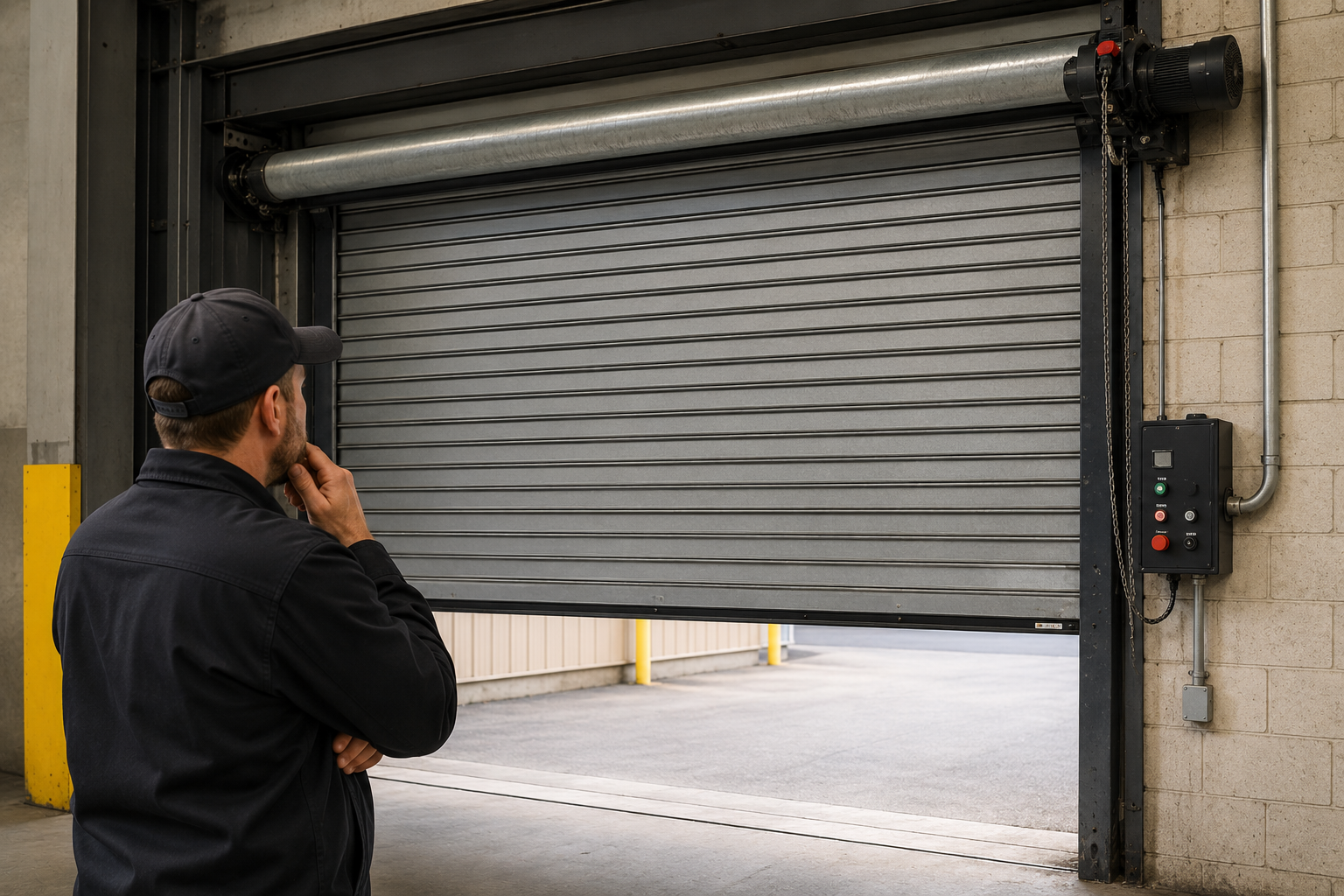
Commercial Roll-Up Door Troubleshooting: What Facility Managers Should Check First
A practical troubleshooting guide for warehouses, storage facilities, retail properties, industrial buildings, fleet operations, and other commercial facilities.
When a commercial roll-up door stops operating correctly, the way it fails can tell you a great deal about where the problem may be. A door that will not move at all presents a different troubleshooting path from a door that becomes heavy, travels crooked, binds in the guides, or stops halfway.
Facility managers can often perform useful visual checks without taking the door apart. However, rolling doors contain springs, barrels, shafts, operators, and other components capable of storing significant energy. Spring tension, barrel work, structural repairs, electrical work, and major mechanical adjustments should be handled by qualified personnel following the manufacturer’s instructions.
First: Identify What Type of Roll-Up Door You Have
The phrase “roll-up door” is commonly used for several different products. Before troubleshooting, identify the actual door type because construction, counterbalance systems, guides, operators, and service procedures can differ.
Commercial Sheet Door: Typically uses a continuous corrugated steel curtain that coils above the opening. These are common in self-storage, light commercial buildings, agricultural buildings, and smaller commercial openings.
Rolling Steel Service Door: Typically uses individual interlocking slats and is common in commercial and industrial applications requiring heavier-duty construction, larger sizes, insulation options, wind-load options, security, or more demanding operation.
Rolling Fire Door: A specialized rated assembly that must be maintained and tested according to its listing, manufacturer instructions, applicable codes, and required drop-test procedures.
Manufacturer reference: Overhead Door publishes rolling service doors in multiple constructions, from light-duty Coil-Away models to insulated and heavy-duty Stormtite systems. Overhead Door Rolling Steel Service Doors
Problem 1: The Roll-Up Door Will Not Open
Start by determining whether the problem appears electrical, operational, or mechanical.
What Facility Personnel Can Check
- Is electrical power available to the operator?
- Is the disconnect, breaker, or local power source in the expected position?
- Is an emergency-stop button engaged?
- Is the door mechanically locked?
- Is an interlock preventing operation?
- Does the control station respond?
- Does the motor make noise when commanded to open?
- Is there a visible obstruction in the guides or opening?
If the motor runs but the curtain does not move, the problem may involve the operator drive, chain, sprocket, gearbox, brake, shaft, barrel, or another mechanical component. If the operator is silent, the issue may be electrical, control-related, safety-device related, or an operator fault.
Do not repeatedly press the open control if the door is obviously binding. A powered operator can continue applying force to a mechanically jammed door and increase damage.
Problem 2: The Door Is Suddenly Hard to Open or Feels Heavy
A properly counterbalanced roll-up door should not require extreme effort to operate. A sudden increase in door weight can point toward a spring or counterbalance problem.
Possible causes include:
- Loss of spring tension
- Broken or damaged spring components
- Barrel or shaft problems
- Guide binding
- Curtain damage
- Misalignment
Janus manufacturer guidance: Janus’ commercial spring-tension guidance states that an improperly balanced door may be hard to open or hard to close depending on the amount of spring tension. Janus specifies that spring-tension adjustments are to be performed by qualified personnel.Janus Commercial Spring Tension Guidance
If the door suddenly becomes heavy, take the change seriously. The problem is not solved by installing a stronger operator or forcing the existing operator to pull harder.
Problem 3: The Door Opens Unevenly or the Curtain Travels Crooked
A rolling door should travel smoothly and remain properly aligned with its guides. If one side appears to lead the other, the curtain begins walking sideways, or the bottom bar is noticeably out of level, stop repeated operation.
Possible causes include:
- Guide misalignment
- Damaged guides
- Curtain damage
- Bottom-bar damage
- Barrel or shaft movement
- Counterbalance problems
- Improper installation or structural movement
Continuing to cycle a door that is travelling crooked can deform slats or sheet material, damage guides, increase friction, and turn a smaller alignment issue into a major repair.
Problem 4: The Curtain Binds or Scrapes in the Guides
The vertical guides control the curtain as it moves. A small amount of damage in the wrong place can create significant resistance.
Visually check for:
- Dented or crushed guides
- Loose guide fasteners
- Forklift or vehicle impact
- Debris in the guide path
- Pinched guide openings
- Bent wall angles
- Curtain rubbing only on one side
- Changes in the building opening or structural mounting
Industry reference: DASMA has published troubleshooting guidance for rolling-door installation problems and directs users to its technical data sheets for more complete rolling-door installation checks.DASMA – Five Rolling Door Installation Problems
Problem 5: The Door Stops Partway
A door that starts normally but stops before reaching the full-open or full-closed position may have an operator issue, limit-setting issue, obstruction, guide resistance, or mechanical binding.
Useful observations include:
- Does it stop at the same location every time?
- Does the motor continue running after the curtain stops?
- Does the operator fault or stop immediately?
- Does the door slow down before stopping?
- Is the curtain contacting a guide or other component at that height?
- Do manual and powered operation behave differently?
The exact troubleshooting sequence should follow the operator manufacturer’s manual. Avoid bypassing monitored safety inputs or modifying control wiring simply to keep the door operating.
Problem 6: The Door Makes New Grinding, Popping, or Scraping Noises
Rolling doors are not silent, but a new sound is useful diagnostic information. Listen for where in the travel the noise occurs.
- Scraping near one guide can indicate alignment or curtain contact.
- Popping or snapping can indicate curtain, fastener, or counterbalance issues.
- Grinding near the operator can indicate drive, bearing, gearbox, or shaft problems.
- Noise near the hood or barrel can indicate internal mechanical issues that should be inspected by a technician.
Do not normalize a noise simply because the door still moves. Mechanical problems are often cheaper to correct before the damaged component affects other parts.
Problem 7: The Bottom Bar Is Bent or Damaged
The bottom bar is one of the most frequently impacted parts of a commercial rolling door. Forklifts, pallets, carts, trailers, equipment, and vehicles can strike the door even when the rest of the curtain looks acceptable.
Look for:
- Bent bottom-bar angles
- Twisting
- Damage to weather seals
- Loose fasteners
- Safety-edge damage
- Uneven contact with the floor
- Curtain deformation immediately above the bottom bar
A bent bottom bar can affect how the entire curtain enters the guides and may contribute to crooked travel or binding.
Problem 8: The Curtain Is Damaged
Curtain damage should be evaluated based on both severity and door construction. Rolling steel doors with interlocking slats may allow individual damaged slats to be repaired or replaced in some situations, while a damaged sheet-door curtain may require a different repair approach.
Inspect for:
- Bent or crushed slats
- Separated slats
- Creased sheet material
- Torn curtain edges
- Missing or damaged end locks
- Rust or corrosion
- Curtain rubbing
- Uneven coiling around the barrel
Problem 9: The Door Will Not Stay Closed or Will Not Stay Open
A rolling door that will not remain in the expected position may have a counterbalance issue, brake problem, operator issue, limit problem, or mechanical problem.
Do not attempt to correct this by randomly increasing or decreasing spring tension. Counterbalance adjustment should follow the manufacturer’s procedure and be performed by qualified personnel.
Problem 10: The Operator Runs but the Door Does Not Move Correctly
If a motorized door behaves differently from the door itself, separate the operator problem from the door problem.
A technician may need to evaluate:
- Drive chain or sprockets
- Hoist mechanism
- Gearbox
- Brake
- Limits
- Motor
- Control board
- Safety inputs
- Shaft connection
- Manual disconnect components
Manufacturer reference: Overhead Door publishes commercial operator installation/service documentation that includes troubleshooting and maintenance information for rolling-steel applications.Overhead Door Owner Manuals and Service Documentation
A Note About Lubrication: Follow the Door Manufacturer
Do not assume every roll-up door needs grease added to the barrel or spring system. Maintenance requirements vary by manufacturer and product.
For example, Janus states that its steel roll-up door springs are located inside the barrel and come pre-greased, and that its roll-up doors do not require greasing as routine maintenance. Janus Resources and Maintenance Guidance
This is a good example of why generic maintenance advice can be wrong. Use the model-specific manufacturer’s instructions rather than applying lubricant everywhere a component moves.
When to Take a Commercial Roll-Up Door Out of Service
A facility manager does not need to diagnose the exact failed component to decide that continued use is a bad idea.
Stop operating the door and call for service when you see:
- Severe binding
- A crooked or rapidly shifting curtain
- Broken or visibly damaged spring/counterbalance components
- Major guide damage
- Curtain separation
- A damaged bottom bar affecting travel
- Unexpected free movement or uncontrolled movement
- Electrical burning smell, smoke, or overheating
- A safety device that is not functioning as required
- Any condition where continued operation could cause the door or components to fall or release unexpectedly
Repair or Replace? Ask Whether the Door Still Matches the Application
Repeated repairs can indicate that the problem is not the latest failed part. The facility may have outgrown the door.
Replacement deserves consideration when:
- The opening now cycles far more frequently than it did when the door was installed
- Vehicle or forklift impacts have caused repeated structural damage
- Replacement parts are becoming difficult to obtain
- The curtain or guides are extensively damaged
- Security or insulation requirements have changed
- The door repeatedly causes operational downtime
- A light-duty sheet door is being asked to perform a heavy-duty industrial job
Overhead Door’s current rolling-service-door lineup illustrates the range of available applications: economical light-duty models, heavier-duty rolling steel, insulated doors, weather-resistant systems, and specialized high-cycle/springless products. The correct solution depends on what the opening is expected to do.
Five-Minute Facility Manager Roll-Up Door Check
- Door travels smoothly from fully closed to fully open
- Curtain remains centered and does not rub excessively
- Guides are straight, secure, and free of impact damage
- Bottom bar is straight and seals evenly
- Curtain/slats show no serious deformation or separation
- No new grinding, popping, scraping, or banging noises
- Operator responds normally without obvious strain
- Safety devices and controls are unobstructed
- No visible loose fasteners or structural movement
- Any recurring problem is documented instead of simply reset
This checklist is intended for observation only. Do not remove the hood, adjust spring tension, loosen barrel supports, bypass safety devices, or perform energized electrical troubleshooting unless you are qualified and following the manufacturer’s procedures.
Commercial Roll-Up Door Repair in Arizona
Gecko Service Pros provides commercial roll-up and rolling-door inspection, repair, replacement, operator service, and preventive maintenance for commercial, industrial, municipal, and multifamily facilities throughout Arizona.
Services can include:
- Commercial sheet doors
- Rolling steel service doors
- Rolling door operators
- Guides and brackets
- Curtain and slat repairs
- Bottom bars and weather seals
- Counterbalance and spring systems
- High-cycle applications
- Warehouse and loading-dock doors
- Commercial preventive maintenance
If a roll-up door is binding, travelling crooked, becoming unusually heavy, or repeatedly stopping, do not just keep resetting it. The way the door is failing is often the first clue to what needs to be corrected.
Frequently Asked Questions
Why is my commercial roll-up door suddenly hard to open?
A sudden increase in operating force can indicate lost spring tension, counterbalance problems, guide binding, curtain damage, or another mechanical issue. Do not force the door or increase operator power to overcome the problem.
Why does my roll-up door stop halfway?
Possible causes include an obstruction, guide resistance, operator limits, safety inputs, control problems, or mechanical binding. Note whether it stops in the same place every time and have the system inspected.
Should I grease the springs on a commercial roll-up door?
Not automatically. Maintenance requirements depend on the manufacturer and model. Janus, for example, states that its steel roll-up door springs are inside the barrel and pre-greased and that routine greasing is not required. Always follow the manufacturer’s instructions.
Why is my rolling door crooked?
Guide damage, curtain damage, bottom-bar deformation, barrel or shaft movement, counterbalance issues, or installation/alignment problems can cause crooked travel. Continued operation can make the damage worse.
Can facility maintenance staff adjust roll-up door spring tension?
Spring and counterbalance adjustments can involve significant stored energy. Janus specifies qualified personnel for spring-tension adjustment. Facility staff should follow manufacturer procedures and use trained commercial-door technicians where required.
What is the difference between a commercial sheet door and a rolling steel door?
A sheet door commonly uses a continuous corrugated curtain, while a rolling steel service door typically uses individual interlocking slats. The designs can have different duty, size, insulation, wind-load, security, and repair characteristics.
Industry & Manufacturer References
- Janus International – Resources and Roll-Up Door Maintenance Guidance
- Janus International – Commercial Spring Tension Guidance
- Janus International – Rolling Steel Doors
- Overhead Door – Rolling Steel Service Doors
- Overhead Door – Owner Manuals
- DASMA – Technical Data Sheets
- DASMA – Five Rolling Door Installation Problems
Gecko Service Pros
Residential & Commercial Garage Doors • Gates • Access Control • Commercial Overhead Doors