

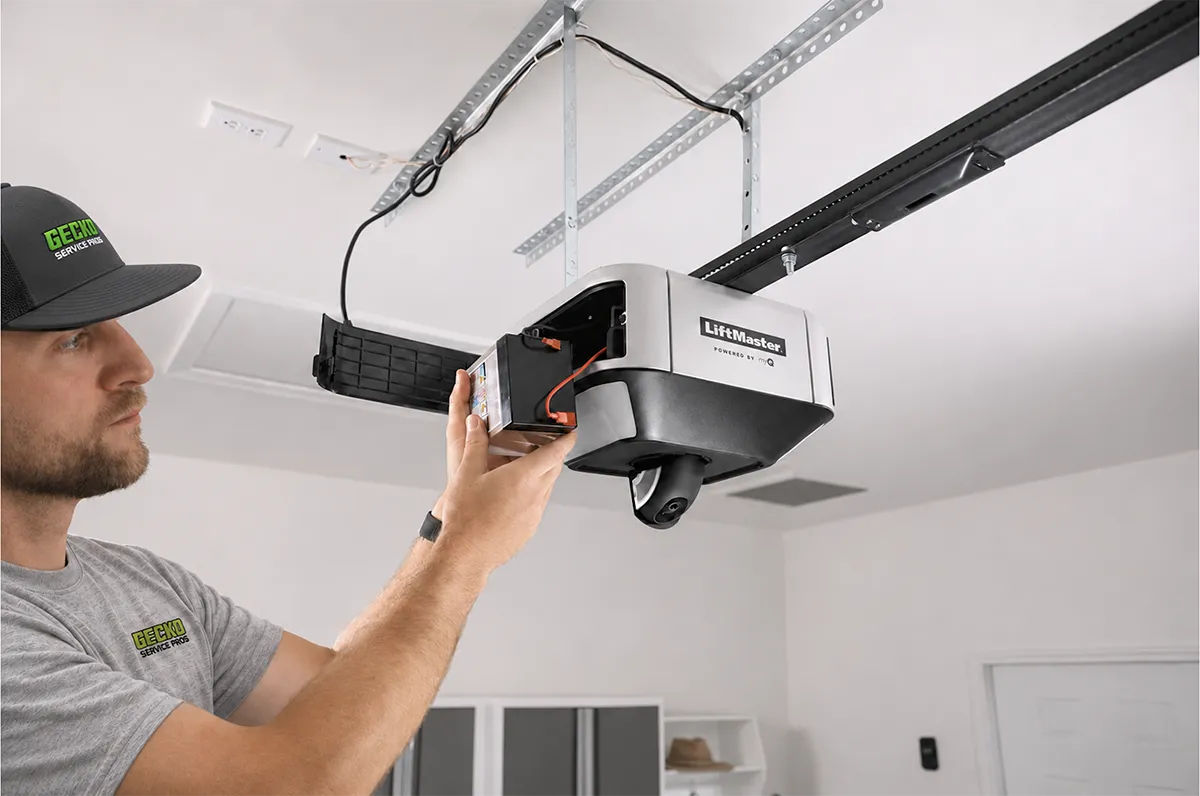
Buying a Garage Door Opener Yourself vs. Through a Professional: Are You Really Saving Money?
You’ve probably seen garage door openers advertised at your local home improvement store or online retailer and wondered: Why would I buy an opener from a garage door company when I can purchase one myself and just pay someone to install it?
It’s a reasonable question. After all, if you find a name-brand opener for $489, it might seem like you’re saving money compared to purchasing a complete system from a professional garage door company.
But here’s what many homeowners don’t realize: The price on the box isn’t necessarily the price of a completely installed garage door opener.
Depending on the model, you may need additional hardware, an extension kit for a taller garage door, or modifications during installation. And if something goes wrong later, the manufacturer’s warranty may cover a replacement part without covering the labor to diagnose, remove, or reinstall it.
At Gecko Service Pros, we believe homeowners should understand these differences before making a purchase. Sometimes buying your own equipment makes sense. Other times, the apparent savings disappear once you compare the complete installation and long-term warranty support.
Let’s take a closer look.
1. The $489 Garage Door Opener: What’s Really Included?
Imagine you’re shopping for a new garage door opener and find a model priced at $489. It’s a recognizable brand, offers smartphone connectivity, and has the features you’re looking for.
You purchase it, bring it home, and call a professional to install it.
Sounds simple, right?
Before buying, however, there are several important questions to ask:
- Does the package include the complete rail and drive system?
- Is the rail designed for your garage door’s height?
- Does the opener use a sectional rail or a one-piece rail?
- Will additional mounting hardware be necessary?
- How much will professional installation cost?
- Who handles warranty claims if the opener fails?
- Will the installation labor be covered if the manufacturer replaces a defective component?
These details can significantly change the total cost.
2. Retail vs. Professional Garage Door Openers: Why Rail Construction Matters
When comparing garage door openers, most homeowners focus on horsepower, smartphone connectivity, battery backup, and price. But there’s another important component that often gets overlooked: the rail system that connects the opener to your garage door.
While retail and professional-grade openers may offer similar features and motor technology, the construction of their rail assemblies can be significantly different.
Understanding those differences can help explain why two seemingly similar garage door openers may have different installed prices.
Retail Openers: Sectional, Snap-Together Rail Systems
Many Chamberlain garage door openers sold through big-box retailers use multi-piece steel rail assemblies. These rails are designed to fit inside consumer-friendly packaging and are assembled during installation.
The individual sections connect to create the track along which the opener’s trolley travels.
This approach makes retail equipment easier to package, transport, and install without specialized delivery equipment.
However, sectional rails have multiple connection points that must be properly assembled, secured, and aligned.
Over time, improperly assembled connections, loose hardware, inadequate support, or excessive operating loads can contribute to rail movement, vibration, and alignment problems.
Although properly installed sectional rails can provide years of reliable service, their construction is an important difference worth considering when comparing retail and professionally supplied equipment.
Professional Openers: The Advantage of a One-Piece Steel Rail
Many professionally supplied LiftMaster garage door opener systems are available with a continuous, one-piece steel rail.
Instead of joining multiple rail sections together, a one-piece rail provides a continuous structure from the opener toward the garage door.
Depending on the opener model and rail configuration, this design can offer several practical advantages:
- No intermediate rail joints that can loosen or shift
- A continuous track for trolley movement
- Reduced potential for movement at sectional connections
- A robust rail configuration suited to professional installation
- Rail lengths selected for the actual garage door height
At Gecko Service Pros, we prefer properly matched professional-grade opener systems with continuous steel rails for many residential installations.
We believe the rail assembly deserves just as much consideration as the opener’s motor, electronics, and convenience features.
Why Rail Alignment and Structural Support Matter
Your garage door opener doesn’t work alone. The motor, drive belt or chain, trolley, rail, and garage door must operate together as a properly installed and balanced system.
If the rail becomes damaged, distorted, improperly supported, or misaligned, it can interfere with smooth trolley movement and create additional resistance during operation.
That resistance may contribute to excessive noise, vibration, inconsistent movement, or unnecessary wear on opener components.
Depending on the problem, a damaged rail or mounting system can also affect reliable operation and may trigger the opener’s built-in safety and obstruction detection systems.
It’s important to understand that rail construction alone does not determine how long an opener will last. Proper installation, door balance, spring condition, track alignment, and regular maintenance all contribute to the performance and longevity of the system.
A properly balanced garage door should not require the opener motor to lift the door’s full weight. The counterbalance spring system carries most of that load.
If the door is difficult to move, binds in its tracks, or places excessive resistance on the opener, the underlying mechanical problem should be corrected rather than expecting a more powerful motor to compensate.
What About Motor Strength and Duty Cycles?
Retail and professionally supplied garage door openers may share similar motor technologies, but specifications vary by manufacturer, model, and intended application.
Motor performance should be evaluated based on the actual opener’s specifications, the garage door’s operating requirements, and how frequently the door is used.
For most residential applications, selecting a properly matched opener and ensuring the garage door operates smoothly are more important than choosing equipment based on advertised horsepower alone.
Homes with oversized doors, unusually high usage, or specialized operating requirements may benefit from additional evaluation and equipment specifically designed for those conditions.
The Bottom Line: Compare the Complete System
A retail garage door opener isn’t automatically a bad product, and a professional-grade opener isn’t automatically the right choice for every home.
But when you’re comparing a retail opener to a professionally supplied system, make sure you’re comparing more than the motor and advertised features.
Consider the rail construction, door-height compatibility, mounting hardware, installation requirements, and warranty support.
At Gecko Service Pros, our goal is to provide a complete, professionally matched garage door opener system—not simply install whatever happens to be inside a retail box.
Retail Openers Often Use Sectional Rails
Many garage door openers sold through big-box retailers include a rail assembled from multiple sections that connect during installation.
This design allows the opener to fit inside a box that consumers can transport in a typical vehicle.
Sectional rails are designed for consumer assembly and can work reliably when properly installed. However, their construction differs from the one-piece rail assemblies commonly available with professional-grade systems.
Professional Systems Often Use One-Piece Steel Rails
Professionally supplied garage door openers, including many LiftMaster configurations, use a continuous one-piece steel rail rather than multiple snap-together sections.
One-piece rails eliminate the joints found in sectional rail assemblies and provide a continuous track for the trolley.
At Gecko Service Pros, we prefer properly matched professional-grade opener systems with solid one-piece rails when appropriate for the application.
That doesn’t mean every retail opener is poorly made. It means homeowners should understand what they’re purchasing and why two openers with similar features may have different hardware configurations.
When comparing quotes, ask about the complete opener and rail assembly—not just the motor unit.

3. Have an 8-Foot Garage Door? You May Need Additional Parts
Here’s another expense that can surprise homeowners.
Many standard retail garage door openers are configured to operate a 7-foot-tall garage door.
If your garage door is 8 feet tall, a compatible extension kit may be required. Taller residential or RV garage doors may require additional consideration.
For belt-drive openers, these extension kits can include an additional rail section and a longer belt.
That means a garage door opener advertised at $489 may require another purchase before it can be installed correctly on your door.
For example, a compatible 8-foot belt-drive extension kit might add approximately $70 or more, depending on the model, retailer, and current pricing.
Now that $489 opener could cost approximately $560 in equipment before you’ve paid anyone to install it.
Not every opener requires an extension, and not every product is configured the same way. That’s precisely why checking compatibility before purchasing matters.
When Gecko Service Pros supplies an opener, we evaluate the door’s height, configuration, and operating requirements before recommending the appropriate equipment and rail system.
4. Comparing the Real Cost of a Store-Bought Garage Door Opener
To make an informed decision, homeowners should compare the complete installed cost rather than the retail purchase price.
Consider this illustrative example of a homeowner purchasing a garage door opener for an 8-foot door.
| Expense | Customer-Purchased Opener | Professionally Supplied Opener |
|---|---|---|
| Garage door opener | $489 retail example | Included in quoted package |
| 8-foot rail extension | May cost extra | Correct rail included in quote |
| Installation labor | Additional expense | Included in installed quote |
| Additional required hardware | May cost extra | Specified in installation quote |
| Manufacturer warranty | Varies by product | Varies by product |
| Installer labor warranty | Depends on installer; no Gecko parts or labor warranty on customer-supplied equipment | Gecko’s qualifying residential coverage |
| Future warranty coordination | Customer’s responsibility | Gecko assists with covered claims under its warranty terms |
It’s also important to compare the quality and configuration of the equipment being installed. A professionally supplied opener with a continuous one-piece steel rail may not be directly comparable to a retail opener using a sectional rail assembly, even when both products offer similar motor specifications and smart-home features.
The complete hardware package, professional installation, and available warranty support should all be part of the purchasing decision.
The professionally supplied system may initially appear more expensive, but once you add the necessary accessories and installation charges to the retail purchase, the difference can become surprisingly small.
In some cases, the professionally supplied option may even cost less upfront.
And that’s before considering what happens if the opener fails.
The right comparison is the total installed price, the equipment being supplied, and the warranty protection that comes with it.
5. The Biggest Difference May Be the Warranty
This is one of the most overlooked considerations when homeowners purchase their own garage door opener.
Many major manufacturers provide product warranties covering certain defects in motors, belts, parts, or other components for specified periods.
However, a manufacturer’s product warranty and a professional installer’s labor warranty are two very different things.
What Happens When a Store-Bought Opener Fails?
Let’s say you purchased your garage door opener from a home improvement store and hired a professional to install it.
A year later, the motor or another covered component fails.
The manufacturer may provide a replacement component under its warranty. However, you may still be responsible for:
- Troubleshooting and diagnosing the problem
- Contacting the manufacturer
- Providing purchase records and warranty information
- Obtaining or exchanging replacement components
- Paying a technician to remove defective equipment
- Paying for installation of replacement equipment
- Scheduling additional service visits
Even when the replacement part is free, the service labor may not be.
For example, Chamberlain’s published residential warranty information explains that professional service charges are generally the owner’s responsibility.
It’s important to understand what the warranty actually covers before purchasing.
Gecko Service Pros’ Warranty on Customer-Supplied Equipment
Gecko Service Pros is happy to install certain customer-supplied garage doors and openers when the equipment is appropriate for the application.
However, equipment purchased from another retailer, supplier, or manufacturer does not receive Gecko Service Pros’ parts or labor warranty.
If customer-supplied equipment fails, the homeowner is responsible for contacting the retailer or manufacturer and managing any warranty claim, exchange, or replacement.
Gecko does not process manufacturer warranty claims for customer-supplied equipment. If you would like us to diagnose, remove, repair, or reinstall the equipment, those services are billable at our applicable labor or service rates.
This distinction is important even when the manufacturer provides a replacement part at no charge.
What If You Purchase Your Opener Directly From Gecko?
For qualifying residential equipment purchased through and installed by Gecko Service Pros, we provide a three-year labor warranty from the original installation date.
If the equipment experiences a covered manufacturer defect during that period, Gecko will assist with the manufacturer warranty process and provide the labor needed to remove and replace the covered product at no additional labor charge.
The manufacturer’s product warranty continues to apply according to its individual terms, and Gecko’s labor coverage is subject to our published warranty conditions and exclusions.
That means you have a single point of contact for eligible warranty problems rather than coordinating separately with a retailer, manufacturer, and installation company.
For complete coverage details, please review our Warranty Information page.
6. What About Buying Your Own Garage Door?
The same considerations apply when purchasing a complete replacement garage door from a home improvement retailer or online supplier.
Choosing a replacement garage door involves more than selecting a style, color, and size.
A complete installation requires properly matched components and a system designed for the opening.
Depending on the product and installation, this can include:
- Door panels and insulation options
- Tracks and supporting hardware
- Properly sized springs and counterbalance components
- Cables, drums, rollers, hinges, and bearings
- Weather seals and perimeter trim
- Mounting and reinforcement requirements
- Compatibility with the existing garage door opener
- Appropriate installation and safety testing
One common misconception is that every replacement garage door includes all the hardware needed for every installation.
In reality, what’s included depends on the manufacturer, model, product package, and installation conditions.
Some installations also require modifications or additional components that may not be obvious when purchasing the door.
Arizona Homes Have Additional Considerations
In the Phoenix metro area, garage door insulation, sun exposure, thermal performance, and structural design can affect both comfort and long-term operation.
For attached garages, especially those facing west or receiving prolonged afternoon sun, door construction and insulation can be important factors in selecting a replacement.
When purchasing through Gecko Service Pros, we help homeowners evaluate their options and specify the appropriate door, hardware, and installation requirements for their home.
Learn more about our professional garage door replacement services.
7. Does Buying Your Own Garage Door Equipment Ever Make Sense?
Absolutely. There are situations where purchasing your own equipment may be a reasonable choice.
For example, a homeowner who is comfortable installing a compatible retail opener, has the necessary tools and experience, and is willing to manage future manufacturer warranty claims may find a retail purchase economical.
Some customers also have specific equipment preferences or have already purchased an opener before contacting a professional.
We understand that.
However, if you’re planning to pay a professional for installation anyway, we strongly encourage comparing the complete installed price before purchasing equipment separately.
You may discover that buying through your installer offers similar or better total value, more appropriate hardware, and a simpler warranty experience.
8. Seven Questions to Ask Before Purchasing a Garage Door Opener or Replacement Door
Before making your decision, ask these questions:
- Is the equipment compatible with my garage door? Confirm the door’s height, weight, configuration, and hardware requirements.
- What’s included in the box? Verify the rail, drive components, sensors, controls, and mounting hardware.
- Will I need additional parts? Check for extension kits, special brackets, reinforcement, or other accessories.
- What’s the complete installed price? Compare equipment, required accessories, labor, and any additional charges.
- What does the manufacturer’s warranty cover? Review coverage periods, exclusions, and the claim process.
- Who pays for warranty labor? Determine who is responsible for diagnosis, removal, and reinstallation if equipment fails.
- Who do I call if something goes wrong? Understand whether your installer will coordinate covered warranty service or whether you’ll handle it yourself.
Taking a few minutes to understand these details can help you avoid unexpected expenses and frustration later.
Frequently Asked Questions
Is it cheaper to buy a garage door opener from Home Depot or Lowe’s and pay for installation?
Sometimes, but not always. The retail price may not reflect the complete installed cost. Additional rail extensions, required hardware, professional installation, and future warranty labor can reduce or eliminate the expected savings. Compare complete quotes before making your purchase.
Do store-bought garage door openers include a rail?
Many retail trolley-style openers include a sectional rail assembly designed for standard-height garage doors. However, package contents vary by model. Some professional systems use a continuous one-piece rail. Always verify exactly what is included before purchasing.
Will a standard garage door opener work on an 8-foot door?
Many retail garage door openers are configured for 7-foot doors and require a compatible extension kit for an 8-foot door. Other models and configurations may differ. Check the manufacturer’s specifications before purchasing.
Does the manufacturer’s warranty cover garage door opener installation labor?
Not necessarily. Many manufacturer warranties cover eligible defective components but exclude professional diagnosis, removal, or reinstallation labor. Always review the warranty terms for the specific product you’re considering.
Will Gecko Service Pros install a garage door opener I purchased elsewhere?
Yes, Gecko Service Pros installs certain customer-supplied garage door openers when the equipment is suitable for the application. However, customer-supplied equipment is not covered by Gecko’s parts or labor warranty, and the customer is responsible for handling manufacturer warranty claims.
What warranty do I receive when purchasing a new garage door opener from Gecko?
Qualifying residential equipment purchased through and installed by Gecko Service Pros includes a three-year labor warranty, subject to our published terms. The applicable manufacturer’s product warranty also applies. For covered manufacturer defects during Gecko’s labor warranty period, we assist with the warranty process and provide covered removal and replacement labor without additional labor charges.
Why Purchasing Through Gecko Service Pros Can Be the Better Long-Term Value
At Gecko Service Pros, we don’t believe homeowners should have to guess what they’re getting or discover unexpected costs after purchasing equipment.
We’re a locally owned, family-operated Arizona business serving homeowners throughout Gilbert, Mesa, Chandler, Queen Creek, Scottsdale, Phoenix, and the surrounding Valley.
When you purchase a garage door opener or replacement garage door through Gecko, our team helps you:
- Select equipment appropriate for your home
- Understand the differences between available products
- Get a complete installation quote
- Identify the correct rail and hardware configuration
- Receive professional installation and safety testing
- Understand your manufacturer and labor warranty coverage
- Have a single point of contact for eligible warranty issues
We understand that price matters. But so do reliability, professional installation, and knowing who will stand behind the equipment if something goes wrong.
Before buying that garage door opener or replacement door at a retail store, give Gecko Service Pros an opportunity to quote the complete installation.
You may be surprised at how competitive a professionally supplied system can be—and the long-term value of having the company that installs your equipment stand behind its work.
Request a Free Estimate or call (480) 805-2000 to discuss your new garage door opener or replacement garage door.
Gecko’s Got You Covered!
For more homeowner buying guides, maintenance advice, and repair information, explore the Gecko Service Pros Knowledge Center.